University of Washington
1998 · with Bill Gates
Summary
Program introduction
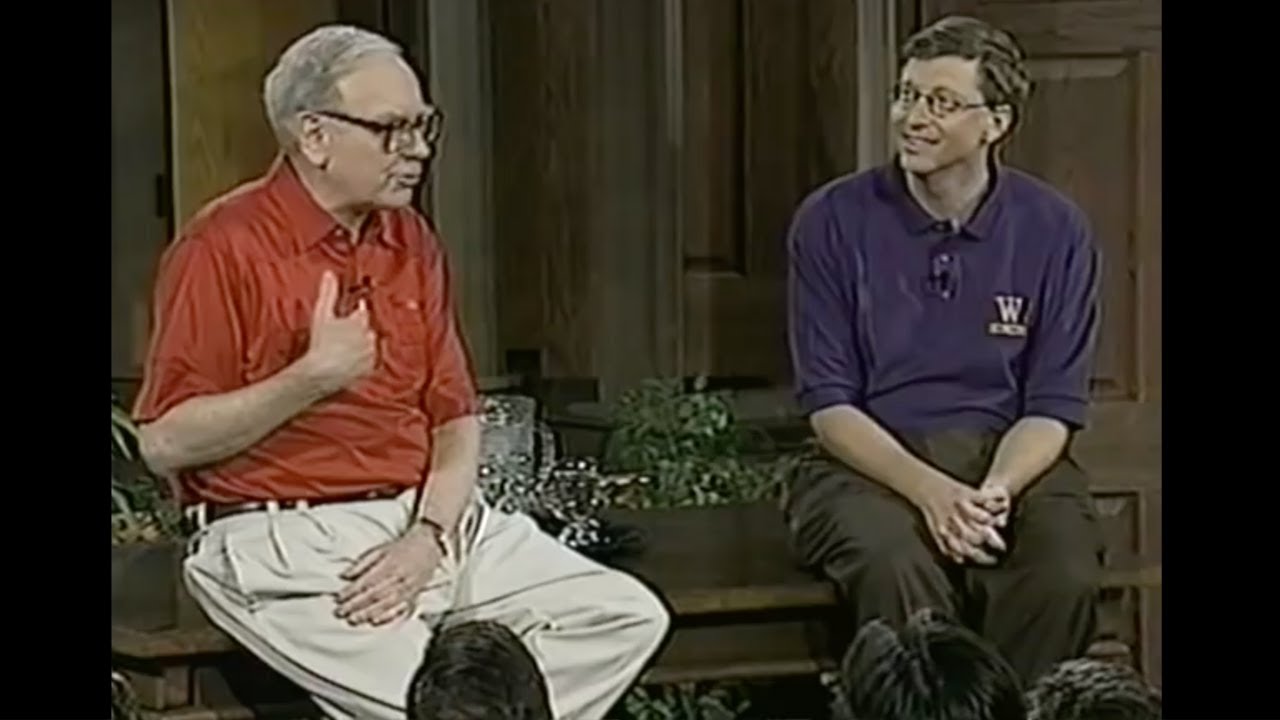
A short documentary segment opens the program. It describes the yearly gathering in Omaha, Nebraska, where thousands of investors come to the Berkshire Hathaway shareholders' meeting, many just to see its chairman, Warren Buffett. It presents him as a stock picker whose net worth is estimated at more than 30 billion dollars, built in well-known companies such as Coca-Cola, Gillette and Dairy Queen, and says he avoids anything high-tech. It then introduces his friend Bill Gates, twenty-six years younger, who started Microsoft with Paul Allen while still in his teens. In the spring of 1998 the two spoke with students of the University of Washington business school.
Habits, rationality and IQ
Buffett begins with a joke about a small bet on who will get more applause, then says that what got him here is not IQ, since everyone in the room has more than the job needs. He treats IQ and talent as the horsepower of a motor, while the output depends on rationality. Many people start with four hundred horsepower and get one hundred of output, and he would rather have two hundred and use all of it. Smart people get in their own way through habits, character and temperament, and if someone falls short of what he does, he says, it will be because they do not allow themselves to do it.
His suggestion is to write down the classmate you admire most and why, then the one you can stand least and why. Neither list will contain things like throwing a football seventy yards. The qualities are ones you can make your own with practice, until they become habits, and the chains of habit are too light to be felt until they are too heavy to be broken. He cannot change his habits at his age, but the students will have in twenty years the habits they decide to practice today.
Gates agrees. Early exposure to computers, and the shared conviction that chips would turn them into something everybody could use, led him and his friends to write software, aiming at a tool that magnifies brainpower instead of muscle power. He hopes the same habits could bring Microsoft close to its original vision of a computer on every desk and in every home.
Enjoying your work and defining success
Asked how he defines success, Buffett says he can define happiness, because that is what he is. He does what he likes every day of the year with people he likes, and does not have to deal with anybody who makes his stomach churn. He advises working for an organization and for people you admire, and worries about those who plan ten years of work they dislike followed by ten more, which he compares, bluntly, to saving up sex for old age.
He does not claim his work is the most important thing in the world, only that he happens to be wired for it. He has turned down otherwise decent deals because of the people involved, comparing that to marrying for money: probably a bad idea under any circumstances, and absolutely crazy if you are already rich. For Gates, enjoyment means very smart colleagues and new problems. He avoids dwelling on success because expectations keep rising and competition never stops, and he calls software the most exciting field there is.
Innovation and staying ahead of the curve
Asked to define innovation, Buffett says he does not do much of it. His job has two functions: allocating capital, and keeping fifteen or twenty managers enthusiastic about work they have no financial need to do. At least three-quarters of them are rich beyond any possible need, so he tries to make them jump out of bed at six in the morning with the enthusiasm they had when they were poor. If he does those two things, he says, they do the innovating.
Gates says no technology company gets to rest on its laurels. IBM was as dominant as any company will ever be in technology, yet it missed a few turns in the road. He admits Microsoft was surprised too: the internet was only a fifth or sixth priority until it proved faster and deeper than expected, and he had to create a sense of crisis as an act of leadership. After a couple of months of discussion and retreats, the company settled on what to do. Such a crisis is likely every three or four years, and his advice for the next is Yogi Berra's: at a fork in the road, take it.
Mentors and heroes
Asked about role models, Gates credits parents who were involved in many activities and talked at home about business, law, politics and charity. He gravitated to scientists, and for a while thought he would be a mathematician or scientist. At Harvard he first thought he should give up his absorbing hobby with computers and do something serious, then realized the hobby was serious, and more interesting and impactful than a new theory in math.
Buffett prefers the word heroes, and says that if you tell him yours he can tell, to quite an extent, how you will turn out. None of his has ever let him down. He names his father, his wife, whom he has never seen better with human beings, and his professor Ben Graham at Columbia. Quoting Yogi Berra, he says you can observe a lot just by watching, and he watched his father and his wife. The right heroes, he says, carry you through the hard periods everyone has.
The internet, children and technology's economic impact
A student asks Gates, as a father, about children's exposure to information online. Gates says the internet holds the worst and the best of everything, so parents must decide whether to let a child onto it. If set up the right way, it can keep a log of what a person looked at, and a parent must decide up to what age checking it is legitimate. He would rather see what his child is interested in and talk about it than block it altogether, because a curious child will find out somewhere eventually.
Asked whether technology makes business efficient enough to justify paying more for it, Buffett is sure it has made things more efficient, but says many business improvements, perhaps including much of technology, work like standing on tiptoe at a parade: soon everyone is on tiptoe and nobody sees better. Gates sees a one-time lift when a company goes from using technology poorly to using it well. Big earners with returns on equity above twenty percent, such as Coke, Microsoft, Boeing and GE, sell worldwide and were helped by technology, but that cannot explain such returns ten years from now. The real trick, he says, is to be the only one on tiptoe who notices.
Going global
Asked how they take their businesses global, Buffett says Berkshire does it indirectly. Its two largest commitments are Coke and Gillette: about 80 percent of Coke's earnings come from abroad, and two-thirds of Gillette's, both likely to grow. Those companies take part in a worldwide improvement in living standards, so he can sit in Omaha while Doug Ivester and Coke work around the world. Gates has to do it himself for Microsoft.
Gates says software is naturally global: what someone needs from a spreadsheet in Korea or Egypt is about what an American needs, and the PC standard is global. Its market share is higher outside the United States, because local subsidiaries and distribution are hard to set up and most competitors, being American, are less good at international business. Most growth will come from abroad. Buffett adds that fifteen years earlier the country almost had an inferiority complex about computing, and credits Gates with helping change that.
The 1995 trip to China
Asked what led them to travel together to China in 1995, Gates says partly to relax and have fun, and they found a few McDonald's there. Microsoft had already invested a lot there and has increased that since. About three million computers are sold in China every year and people do not pay for the software, but he expects they will. As long as they are going to steal it, he jokes, he wants them to steal Microsoft's, so that they get addicted and the company collects in the next decade. Buffett says his family was amazed, since he had never traveled much beyond his county in Nebraska, and the trip confirmed his feeling that a lot of Coca-Cola would be sold there.
Giving back
Asked about giving back, Buffett says both have a similar philosophy. More than ninety-nine percent of his wealth will go back to society, counting everything his family and he have lived on, because society has treated him extraordinarily well. He is wired in a way that is well adapted to a big capitalist economy, though not to pro football or violin playing, and dropped in some remote country he would not have been worth much.
Gates calls this a great philosophy, adding that passing along lots of money can be a bad thing for those who receive it. Buffett says the Nebraska quarterback should not be the eldest son of the quarterback of twenty-two years earlier. If we want meritocracy in athletics, we should want it in what people carry into the world as productive goods. Resources should flow to those who use them best, and then be given back. He does not believe in the divine right of the womb.
The information age and global competitiveness
A student asks which countries and companies are best prepared for the information age. Gates starts with the United States, which emerged in a very strong position from the way it allocates capital and lets labor move, so it will be the first beneficiary. Singapore, Hong Kong and the Scandinavian countries adopt the technology at about the same rate, and Korea and many parts of China stand out for their income level, because families see computers as a way for their children to get ahead.
He expects income to depend less on the country you live in and more on your education. A PhD in India earns far less than one in the United States today, but once the internet moves services and advice as efficiently as shipping moves goods, there will be an open market bidding for the engineer in India against the engineer in the United States. Developed countries gain first, he says, but in the long run the people lucky enough to get a good education in developing countries will get the biggest boost of all.
Predictable businesses versus the exciting and uncertain
Buffett agrees the technological revolution is huge and will change the world quickly, but says his approach is the opposite of Gates's: his is right for the world, Buffett's is right for him. He looks for businesses he can picture ten, fifteen or twenty years ahead. He does not think the internet will change how people chew gum, the fact that Coke will be the drink of preference, or the fact that people will like a better shaving system such as the Mach3. You will not find the very predictable in what Gates does. As a member of society he applauds it, and as an investor he keeps a wary eye on it.
Gates agrees strongly. In his view technology multiples should be quite a bit lower than those of Coke and Gillette, because technology is subject to a complete change of the rules. He knows that over the next ten years, if Microsoft is still a leader, there will have been at least three crises in which it must prove its excellence. Buffett says he wants a business he can run at a hundred, and plans to retire about five years after he dies.
Starting a company
Asked how to judge when to start a company, Gates says he did not think of starting Microsoft as very risky, because he was so excited. He could have gone bankrupt, but his skills were highly employable and his parents would have let him return to Harvard. What scared him was hiring friends who expected to be paid. When customers he had counted on went bankrupt, he developed a very conservative approach: enough money in the bank to pay a year of payroll even if nothing came in.
Starting a company takes so much energy that you must overcome your feeling of risk, he says, and he does not think you should necessarily start at the very beginning of a career. Youth brought obstacles: he could not rent a car under twenty-five, or go into the bar where discussions took place. But when skeptics see you really have a good product, they tend to go overboard the other way.
The best and worst business decisions
Asked for his best business decision, Buffett says simply getting in, jumping in the pool. Chances come that practically shout at you, and when one does there is no time to read a book on the theory of diversification: it is time to take your thumb out of your mouth and barrel in. That applies when the business is within your circle of competence, the price is right and the people are right.
Gates says they discussed at breakfast Buffett's worst decision, and decided that, by some metric, it was probably buying the company his is named after. Buffett agrees: his cigar-butt approach, a soggy butt on the ground with one puff left, free. Berkshire was selling below working capital, and buying control of it was probably his biggest single bad decision. The decisions that cost billions were mistakes of omission rather than commission. He does not worry about missing Microsoft or Intel, which he did not understand, but he understood Fannie Mae, decided to buy and did not execute, and conventional accounting does not record that.
Gates says his best decisions concern picking people: partnering with Paul Allen, then hiring his friend Steve Ballmer, someone he trusts who shares his vision, has slightly different skills and checks his ideas. Buffett has had that in Charlie Munger for many years. If Munger calls something dumb, Buffett takes it as approval, and if he says it is really dumb, he knows it is.
Regrets, luck and time
Asked what he would change about his life, Buffett answers: his age. He never looks back and considers himself unbelievably lucky. You play the hand you get as well as you can, and are thankful if lucky. When he was born the odds were over fifty to one against being born in the United States, and he also had two terrific parents.
Gates says the key resource is time and how you spend it. He looks back rigorously each year and even asks Steve Ballmer to review his schedule and criticize it, pointing out what he did not need to spend time on. That helps him gain more time with engineers and customers, which he loves and which clears his mind, so that he does only what is important.
Starting over from scratch
A student asks what three things each would keep if they lost everything and started fresh. Buffett would like to keep what he knows, since what he applied in the past will apply in the future. Losing his own money would not bother him much, because he would live about the same way, giving up the plane while eating as everyone in the room does. What would destroy him is taking other people's money down with him. With his knowledge and a few dollars from someone, he says, playing the game again would be about as much fun as now.
Gates is also attracted by starting small again, noting that in his business money makes little difference. If the top thirty people were drafted onto the other team, he says, the score would change quickly, and those who like working with them would follow. The value lies in the people, their sense of how to do things and their enjoyment of working together.
Antitrust
A student asks about the role of antitrust law amid the public controversy. Buffett, jokingly calling himself an antitrust scholar, recounts that Gates spent six or seven hours explaining his business when they met eight years earlier, after which Buffett bought a hundred shares just to keep track of the company. That shows two things, he says: his IQ is about fifty, and he did not think Gates had any monopoly.
Gates says competition law exists to protect consumers and ensure that innovative products get created. By that measure the personal computer industry stands out as the best sector of the economy. Computing prices fall at an incredible rate, software variety and quality have grown phenomenally, and new software companies, jobs and investment are well above three years ago. He is surprised to find Microsoft in an antitrust controversy.
Succession planning
Asked how their companies will cope after them, Buffett says the assumption is wrong because he will work until about five years after he dies, and he has given the directors a Ouija board. If it fails, Berkshire has outstanding people who can do what he does, identified and known to the board. He has already sent a letter on what should be done and has another, addressed, that begins "Yesterday I died" and sets out the plan. At the bottom he wrote: dictated but not read.
Gates wants to keep doing what he does for a long time. Perhaps a decade from now, while staying fully involved because it is his career, he will pick someone else as CEO, and he notices hands in the audience. He is interested in people who want the job, which has some fun parts. It is a big transition for a company.
Raw automatic captions from YouTube, in English, without edited punctuation.