Georgetown University
September 19, 2013
Summary
Welcome and introductions
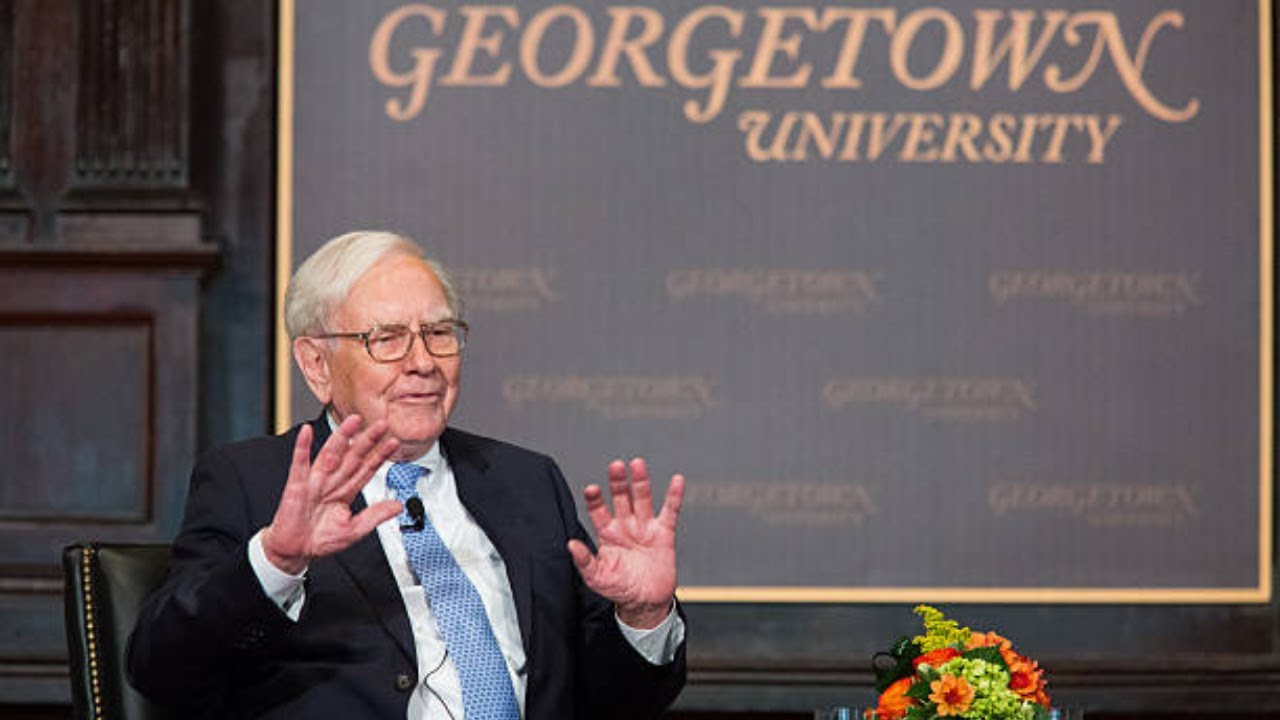
An MBA student, Lindsey Bruen, opens the evening at Georgetown's McDonough School of Business and describes how the school's Global Social Enterprise Initiative, backed by Bank of America, shaped her own path. University president Jack DeGioia welcomes the guests and notes that Buffett went to high school near Washington while his father sat in Congress. Brian Moynihan, chief executive of Bank of America, explains that Bono told him to bring a real rock star. He will ask Buffett questions for twenty-five or thirty minutes, and then the students will take over.
Growing up near Georgetown
Asked for his best memories, Buffett says he delivered papers at Georgetown Hospital sixty-six years ago and liked that route because patients tipped, while his regular customers never did. New mothers would whisper the exact weight of the baby, which they believed was valuable information for the numbers racket then popular in Washington. He also remembers the Second World War years, when his father was in Congress. He says the country was more united then than at any time in his life: athletes enlisted at once, people followed gasoline, sugar and meat rationing voluntarily, and schoolchildren bought savings bonds.
Early interest in investing
Moynihan asks how the fascination with investing began. Buffett says it took him five years to save 120 dollars to buy three shares of Cities Service Preferred when he was eleven. His father worked in the investment business, and Buffett read the books in his office on Saturday mornings, then read every investment book in the Omaha Public Library. Once in Washington he had the Library of Congress. He adds that his legs may be gone, but that does not matter for his work, and he has as much fun now as ever. He jokes that crowds applaud at the start because he is eighty-three.
The Giving Pledge
Buffett says that three or four years earlier he, Bill and Melinda Gates asked David Rockefeller to host a private dinner in New York for sixteen or eighteen people, including Oprah Winfrey and Mayor Bloomberg. Each guest explained how they had developed their philosophy of giving. He and Gates then decided to ask other wealthy people to pledge at least half their net worth. About 115 had signed, and Buffett has been calling billionaires himself. He tells of a woman whose husband had more than ten billion dollars: she wrote that they had not faced the decision, but over half would now go to philanthropy. People postpone, he says, so he asks whether judgment will really be better at ninety-five.
Moynihan asks whether this replaces having his own foundation. Buffett says he and his wife planned to give away what they did not need, but she died in 2004. Citing Adam Smith on specialization, he says he goes to an obstetrician or a dentist rather than doing the work himself, so he wanted people who are very good at giving money away. The Gates Foundation starts from the principle that every human life has equal value. He also funds foundations run by his three children and tells them to swing for the fences. After his death, all the money must be spent within ten years after the estate closes, because he does not believe in controlling things from the grave.
East Lake and community redevelopment
Moynihan raises East Lake, the Atlanta golf course, and Tom Cousins. Buffett says it follows the same theory: backing people who put their own time and energy into a project that is succeeding. Cousins took a crime-ridden neighborhood where nobody did well in school and, against community opposition, applied a holistic approach rather than attacking one problem at a time. After about ten years he had built an entirely new community. Buffett warned him that critics would say it worked only because he was Tom Cousins in Atlanta, so Cousins, Buffett and Julian Robertson tried to replicate it. It worked in New Orleans and Indianapolis in mixed-income communities, and about eleven more towns are in progress.
The economy since the 2008 panic
On the economy, Buffett says his businesses have come back well from the panic five years earlier, which he calls worse than anything anyone had seen. He credits Ben Bernanke, Hank Paulson, Tim Geithner and, though he never voted for him, President Bush, who summed up the problem in about ten words: if money does not loosen up, this sucker could go down. Many companies now report record profits, but the public has not come back the same way. The Forbes 400 holds two trillion dollars, against 300 billion twenty years ago, while median income in real purchasing power is about where it was in 1989. The bottom fifth of households top out at about 22,000 dollars.
Moynihan asks how the country grows out of this. Buffett says it is already growing: even 2 percent a year, with population up about 1 percent, gives a 20 percent gain in GDP per capita over a generation. The question is how that gain is distributed. Since his birth in 1930, he says, real GDP per capita has risen six-fold, and he considers a baby born today in the United States the luckiest person on a probabilistic basis. The market system works, but everybody should participate to a reasonable degree. He does not want equality of results, only a satisfactory base level.
Lessons from market cycles
Moynihan asks what young investors should learn from recent cycles. Buffett answers that people keep making the same mistakes, and this does not correlate with IQ. Housing, the most important asset most Americans have, became a huge bubble because they could borrow heavily against it, and conditions grew lax. People enter a bubble gradually, but when they get scared they all want to leave at once. That will happen again in different circumstances. Still, the twentieth century held two world wars, the Great Depression and the Cold War, and the Dow rose from 66 to 11,497. America works, he says, and a prosperous society must make sure nobody is left too far behind.
On America's optimism
Asked what makes him optimistic about the next decade, Buffett asks the audience to imagine 1789, when there was little here. He cites the plaque for Sir Christopher Wren in St. Paul's, which tells visitors to look about them, and says the same applies to America. The country had fewer than four million people at its founding, when China had 300 million and Europe about 75 million, who were just as smart and hardworking. Yet America ended with a quarter of world GDP. He wrote in The New York Times in fall 2008 that the country would come back, and it has. So don't ever worry about America, he says.
The GEICO story
Moynihan asks for his favorite time of investing when the chips were down. Buffett says his favorite is always tomorrow, then tells the GEICO story. In 1951, at twenty, he came to its Washington offices on a Saturday because his Columbia professor Ben Graham was its chairman. The door was locked, so he pounded on it until a janitor let him in. A man named Lorimer Davidson then spent four hours teaching him about insurance. Buffett draws a lesson: you will receive help from wonderful people, nobody does it alone, and we all sit in the shade of trees planted by others.
The first stock Buffett ever sold went to his Aunt Alice, who bought 100 shares of GEICO. In 1976 the company was in big trouble, having miscalculated its reserves, and he bought a third of it in the market in a short time. By 1995 that third had become a half through share repurchases. He visited Davidson, then ninety-six or ninety-seven, who held stock with no cost basis. Buffett explained that a cash offer would bring a large tax bill, while holding until death would give a stepped-up basis, so he would not offer unless Davidson agreed. Davidson said he had hoped for this all his life, and Berkshire bought the rest.
Stock tips for students
The student questions begin with Cassin Tavallali, who asks for stock tips. Buffett jokes that he did not think Georgetown taught that. The best investment he ever made, aside from his two marriage licenses, was a book he bought in 1949, Ben Graham's The Intelligent Investor. What matters, he says, is a sound framework, and with the right philosophy you will find opportunities over decades, most likely in a panic, when stocks sell at silly prices. It takes little IQ to see they are cheap, but it takes temperament to act. You must ignore what others say and ask whether a stock selling at X is worth 2X. When you do not find that, you do nothing.
International investing: Israel and Brazil
Nicholas Walker asks whether Buffett's past investments abroad, and the Heinz deal with Jorge Paulo Lemann's 3G Capital, mean Brazil is next. Buffett says he does not know where he will invest next, and that is what makes the job interesting. On Israel, in fall 2006 he received a page-and-a-half letter from Eitan Wertheimer, whom he had never heard of, about a company called Iscar. The family would sell only to Berkshire. Berkshire handed them 4 billion dollars for 80 percent of a company he had never seen. Wertheimer urged him to visit, and Buffett agreed to come if they bought it. He went, and says it was the greatest operation he had ever seen.
On Lemann, Buffett calls him and his associates sensational people. He got to know Lemann while on the board of Gillette, and Lemann's team does all the heavy lifting and runs the business. Last December, on the way back from a meeting in Boulder, Colorado, Lemann described his idea about Heinz, and Buffett said to count him in. Lemann then sent a one-page description of how governance would work between them and a brief outline of a fair deal. Buffett did not have to change a word, and he says those are the people you like to associate with.
Derivatives and the next crisis
A student notes that derivatives, once called weapons of mass destruction by Buffett, now total $700 trillion, and asks whether this sets up the next crisis. Buffett says it is very hard to say. He recalls that in fall 2008 the Federal Reserve put 85 billion dollars into AIG, and Hank Paulson guaranteed money market funds when 300 billion dollars had left non-government funds in three days. He does not think either action could be taken under Dodd-Frank today. When there is a panic, the only thing that stops it is someone with the ability and the will saying they will do whatever it takes, and being believed.
Buffett worries that Congress dislikes giving anyone that much authority and is unsure whether what has been enacted since is a plus or a minus. There will be another panic, and the question is whether those in charge act or freeze. It is very hard to write regulations that stop foolish behavior when it has been profitable for several years. He compares people to Cinderella at the ball: the music gets better and the drinks flow, they plan to leave two minutes before midnight, but there are no clocks on the wall. It will happen again, he says, but buy when it does.
Inequality and a fair system
John Ruff, from Georgia, says class mobility and middle-class household income have trended down since the 1970s, and asks how a rising tide can lift all boats and not just the yachts. Buffett says the yachts have indeed been lifted. He sees a structural problem: as a market system becomes more specialized, fewer people fit all the job requirements. In an agrarian society most people fit most jobs, but now a significant share of society is not needed to keep GDP rising, and the market will not pay them well. Government has to address that.
Buffett then offers a thought experiment he puts to students. Twenty-four hours before you are born, a genie tells you to design the economic, social and political system you and your descendants will live in. The catch is that you then draw one slip from a barrel of seven billion, one for every human being. You might be male or female, strong or infirm, bright or below average, born in the United States or in Bangladesh. You want a system that produces lots of goods and services, then one that eliminates fear from everybody's life and takes care of those who draw bad tickets.
America has done a wonderful job on the first stage, he says, and has thought a fair amount about the second, as with Social Security. Now it needs to focus on helping those who draw the bad tickets. He notes that the country said in 1776 that all men are created equal, yet in 1789 counted enslaved people as three-fifths of a person, and passed the Nineteenth Amendment for women only in 1920. The country has moved significantly in the right direction in behaving better, and has done terrifically at producing goods. Helping those left behind can only come through government.
The Fed and tapering
James Fishback, a first-year student, notes Bernanke is stepping down in January and asks whether his successor should continue bond buying. Buffett says they should take Bernanke's approach and keep going until the economy improves more. Bernanke does not pre-judge the date but states the conditions under which he will change course. Buffett adds that this is an experiment not tried before: the Fed has a 3.5 trillion dollar balance sheet, and buying securities is usually easier than selling them. The hint of tapering a few months earlier moved the ten-year yield by perhaps 100 basis points. He calls the Fed the greatest hedge fund in history, financed by currency in circulation, which costs nothing, so nothing presses it to deleverage.
Staying within your circle of competence
A graduate student named Shirley, from China, says business models are changing, with online shopping and perhaps paying by iPhone, and asks what a dinosaur like Buffett will do. He replies that there are all kinds of businesses he does not understand, but thousands of opportunities remain. He turns to Ted Williams, whose book The Science of Hitting divided the strike zone into seventy-seven squares. Williams said swinging only in his sweet zone would give a .400 average, while swinging at low outside pitches would give .230. In investing, Buffett says, there are no called strikes: he does not have to swing at Microsoft or General Motors, and can wait for something he understands at a price he likes.
He tells students that if they were given a punch card with twenty punches for all the investment decisions of their lives, they would get rich, because they would think hard about each. Four or five right decisions would probably be enough. He tips his hat to Jeff Bezos but says he could not have predicted Amazon would succeed where ten others would not, and he does not have to. He formed opinions on Bank of America and Coca-Cola instead. Coke has existed since 1886 and sells 1.8 billion servings a day, so a penny more per serving is about 6.57 billion dollars a year. He likes products that travel, such as soft drinks and ketchup.
Closing remarks
Moynihan thanks Buffett and tells the students that here is someone who, at eighty-three, still wants to make the right investment decision, and who also does something with his wealth to help near-term social goals. Few people have done both as well. Novelli jokes that he has never before heard a positive outcome for the 1929 crash, and says the evening showed how economic and social impact fit together. He calls Georgetown the right place for this, describes the student-led Global Social Enterprise Initiative, and apologizes that not every student could ask a question.
Raw automatic captions from YouTube, in English, without edited punctuation.