University of Georgia
2001
Summary
Introduction
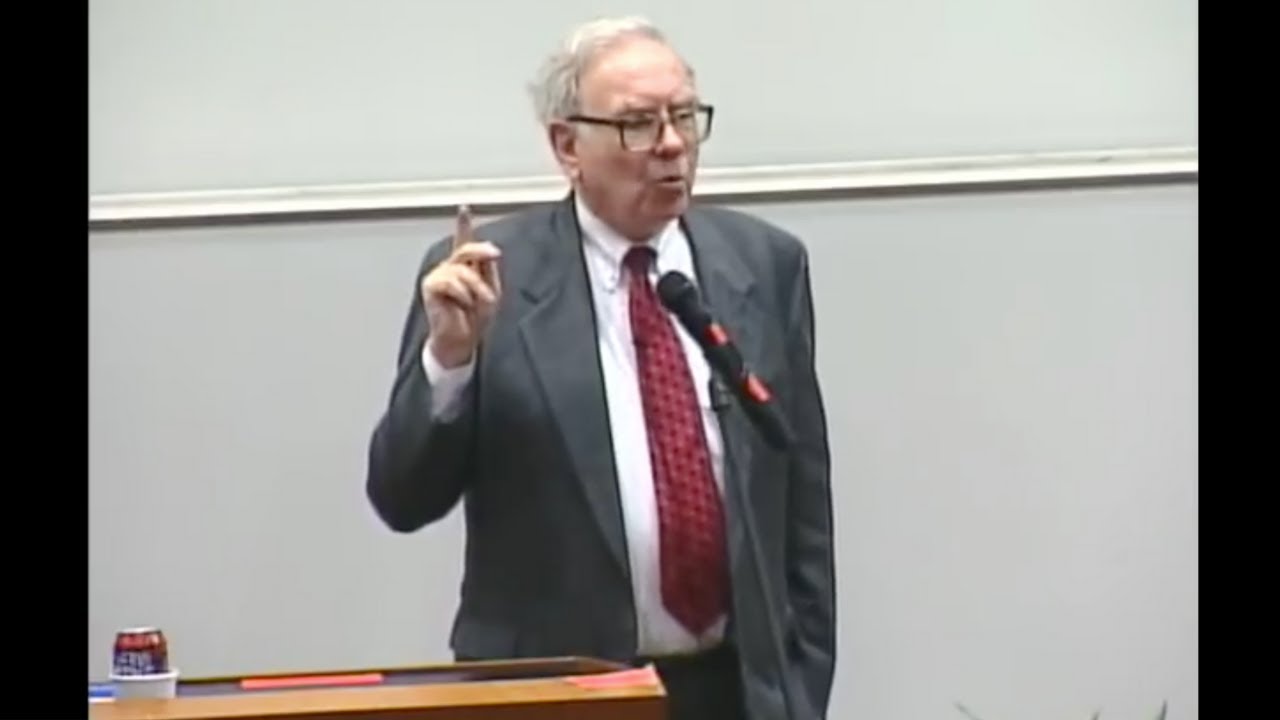
A moderator opens the morning at the University of Georgia business school by calling it an honor to host the world's greatest investor. He presents Buffett as chairman of Berkshire Hathaway, a holding company with stakes in GEICO, American Express and Coca-Cola and with Borsheim's jewelry store in Omaha. Berkshire went from about 18 dollars a share in 1965 to around 69,100 dollars, and is now worth more than 100 billion dollars. He adds that Buffett admits his mistakes openly and avoided the dot-com craze. The session will be mostly questions.
Opening remarks: who to work for
After a joke about Nebraska football players and their agricultural economics final, Buffett turns to a question he is always asked: whom should a graduate work for? His answer is to work for an institution or a person you admire. Taking an in-between job because it looks good on a resume, or pays a little more, makes little sense. He tells of a Harvard Business School student who planned to join a big consulting firm to round out his resume, though he did not want that work and would get to what he liked someday. Buffett compared that to saving up pleasure for old age. Work for whomever you admire most, he says, and you will jump out of bed with enthusiasm.
The thought experiment: whom would you buy 10% of?
Buffett asks the students to imagine choosing one classmate and receiving 10 percent of that person's lifetime earnings. Family wealth does not count, so the choice must rest on merit. He argues that you would probably not pick the best grades. What sets a big winner apart is a set of self-made qualities: integrity, honesty, generosity, and a willingness to do more than your share. Height, speed and looks do not matter.
There is a catch: you must also sell short one classmate and pay 10 percent of what that person earns. The likely loser is not the one with the lowest grades but the one who fails on character: someone who claims credit for work he did not do, cuts corners, or cannot be counted on. When hiring, Buffett looks for intelligence, energy and integrity. Without the third, the first two are dangerous, because a person without integrity is better lazy and dumb than smart and energetic.
He says you cannot change your wiring much, but you can change what you do with it. These qualities are habits, and the time to form the right ones is at the students' age. He quotes the saying that the chains of habit are too light to be felt until they are too heavy to be broken. Ben Franklin and his old boss Ben Graham decided in their teens whom they admired and set out to behave likewise. Anyone in the room can become the person they would buy 10 percent of.
Circle of competence
Buffett says he expects to make money only on things he understands, meaning he can judge what a business's economics will probably look like in ten or twenty years. He can do that for Wrigley, because the internet will not change which gum people chew. Industries that are obviously important are harder to call. There were about two thousand car companies in the early twentieth century and basically three survived. In 1905 the easier insight was to be short horses, since there were 20 million in 1900 and about four million now.
Other important industries rewarded few investors. Over 400 aircraft companies existed in the 1920s and 1930s, and by the end of 1991 the airline industry's aggregate earnings came to less than zero, though passengers grew every year. Coca-Cola, by contrast, began in 1884 and now sells roughly 1.1 billion servings a day. Predicting that an industry will thrive differs from understanding a business's economics. He loves the computer but cannot tell who will win among internet firms, so he does not invest.
The size of the circle does not matter, Buffett says. What matters is knowing where its edge lies and staying inside it, as Tom Watson Sr. put it: smart in spots, and staying around those spots. Straying into something you do not understand because neighbors are excited about rising stocks is how you eventually get creamed, and deservedly so. Understanding a few things and sticking to them is enough to do fine.
Intrinsic value and the birds in the bush
A student asks how to find intrinsic value. Buffett defines it as all the cash a business will give you between now and Judgment Day, discounted at the proper rate. The only reason to lay out money now is to get more later. A bond prints its cash flows on its face, but a stock certificate does not, so the analyst's task is to turn the certificate into a bond by estimating what the business will pay out, when, and how surely.
He applies it to Coca-Cola, then valued at 110 to 115 billion dollars. Would you lay out that sum to receive what the company delivers over the next two or three hundred years? Analyst recommendations, trading volume and charts are beside the point. For Berkshire the question is whether it could distribute enough cash soon enough to justify its price at present interest rates. If you cannot answer, you are gambling, and he cannot answer it for internet companies.
Asked why he has not written down his formulas, Buffett says he has, in the annual reports, borrowing from Aesop: a bird in the hand is worth two in the bush. He adds the missing part. How sure are you that there are two birds, and how long must you wait? At interest rates of 15 percent you need two birds within five years, while at three percent you can wait twenty. With many internet companies there were no birds in the bush, yet people gave up the bird in hand.
Mistakes of commission and omission
Asked about memorable failures, Buffett starts with buying Berkshire Hathaway itself. Taught by Ben Graham to buy cheap on a quantitative basis, he hunted what he calls cigar butts: soggy cigars with one free puff left. Berkshire was a poor textile business selling below its working capital per share, and twenty years later he was still running a poor business whose money did not compound. He now prefers a wonderful business at a fair price to a fair business at a wonderful price, because time is the friend of the wonderful business and the enemy of the lousy one.
He lists more errors. He bought US Air preferred stock in 1989, and as soon as his check cleared the company went into the red. At about twenty he put 2,000 of his roughly 10,000 dollars into a half interest in a Sinclair filling station and lost it all in 1951, an opportunity cost he puts at six billion dollars today. Yet the biggest mistakes are omissions: things within his circle of competence that he failed to do because he was sucking his thumb. He estimates that passing on Fannie Mae when it was in trouble about twenty years ago cost Berkshire at least five billion dollars, a loss that never shows up in conventional accounting.
Big opportunities must be seized, and acting on a small scale is almost as bad as not acting. He imagines a punch card with twenty punches, one used by every major financial decision. People would think hard before each choice and never buy a stock they cannot even name because a neighbor made money last week. He blames the temptation to dabble, especially in bull markets and online, where a click is all it takes.
When to sell, and the marriage analogy
A student asks about sell discipline. Buffett says it has changed. When he started he had more ideas than money, combing Moody's Manual page by page and finding stocks at one or two times earnings, so he sold his least favorite holding to buy something better. Now Berkshire has more money than ideas. It generates at least five billion dollars of cash a year, about a hundred million every week, so the challenge is putting it out intelligently.
He explains the policy set out in the annual report. He treats shareholders as partners for life and tells them in advance how he thinks. Berkshire will not sell its wholly owned businesses, such as See's Candies, the Buffalo News or Borsheim's, even at three times their worth. It might sell if management disappointed or the economics changed greatly, but not merely because a price looks high.
To make the point about expectations, he compares it to marriage. If you want a marriage that lasts, you look for one quality in a spouse: low expectations. He wants his partners to arrive with modest expectations for the same reason, because Berkshire is a financial marriage and he does not want anyone to think he will do things he will not do.
Tax shelters and the line with fraud
A student notes that reputable companies are fighting the tax authorities over artificial shelters, and asks whether investors benefit and whether the notes to the accounts should disclose them. Buffett separates legal shelters from evasion. Berkshire has used low-income housing credits, which Congress created on purpose, and they are minor to its value. Evasion is a different game, and those responsible belong in jail.
He says the tax code is the rule book, and some people bend it so far that they get close to fraud or cross the line, and then they should be prosecuted. He sees more of this in the last five years, including aggressive marketing by auditing firms with percentage fees and shopping for legal opinions, so that anyone caught can claim to have relied on one. He knows of none involving Berkshire and does not want to be near it.
Philanthropy and Bill Gates
Asked about philanthropy, Buffett praises Bill Gates, whom he will meet that week in Seattle at a United Way event. Gates plans to give away over a billion dollars a year, and he approaches it rationally and with deep study, reading fifteen books a month on the subject. His goal is to save as many lives per year as possible, a metric that plays the role return on capital plays in a business. That has led him into vaccines and AIDS in Africa.
Buffett says nearly all of his net worth will go to a foundation after the later of his and his wife's deaths, because he got it from society and it should go back. He keeps very few trustees, since large boards drift to the lowest common denominator, and he gives no specific instructions, because their judgment above ground will beat his from six feet underground. He wants funds directed at problems with no natural funding constituency or that are very hard to solve, not an eyedropper of small gifts. If they try big and fail, he will not mind.
He describes his own fortune as luck. He was wired to be good at allocating assets and was dropped into a huge capitalist society at the right time. Born in 1930, he says the odds were 50-to-1 against being born in the United States. He does not feel guilty, but the money should go back, administered by high-grade people, where high grade matters more than extra IQ.
A century of stock markets and investor psychology
Asked to compare the recent boom and bust with the 1920s, Buffett starts with the whole twentieth century. Per-capita GDP in the United States rose 610 percent, and it rose in every decade. The stock market behaved very differently. From 1900 to 1921 the Dow went from 66 to 71. It reached 381 in September 1929, then fell to about 180 by 1948. It rose to close to a thousand by 1965 and stagnated until 1981 before the latest surge. Over the hundred years it rose 180-fold, but 43 and three-quarter years of bull markets account for almost all of it, and 56 and a quarter years were stagnation.
His explanation is that investors behave in very human ways. They look in the rearview mirror: after gains they pile in and borrow, or copy a neighbor who made money, and after no gains they decide it is a lousy place to be, whatever the businesses are doing. In 1970 pension funds put more than 100 percent of new money into stocks, and in 1978, when stocks were far cheaper, a record low nine percent. People get greedy when others are greedy and fearful when others are fearful. The answer lies in temperament more than brains: if you can detach from the crowd, you can get rich without being especially bright.
Things that do not make sense can go on a long time, Buffett says, but they end, quoting Herb Stein: anything that cannot go on forever will end. Internet companies priced at billions with no prospect of profit were a bubble. His test is to ask whether you would buy the whole business. A company with 100 million shares at 100 dollars is a ten billion dollar price, and it would have to deliver 700 or 800 million dollars soon, then grow. Few businesses can, though it is fun to keep playing, like the brokerage sign that says avoid hangovers, stay drunk.
The Federal Reserve and the limits of monetary policy
Asked about the Federal Reserve, Buffett says he is a fan of Alan Greenspan, whom he has known for a long time, and sees him as motivated entirely by the good of the country. His worry is that Greenspan's tenure coincided with the great bull market, so he might be blamed if things sour. The Fed is less powerful than its mystique, because its brake works better than its gas pedal. Paul Volcker broke inflation around 1980 by braking hard, though he was crucified for it. Stepping on the gas is different: many other variables act at once, and Japan shows that zero interest rates can fail to stimulate anything. Easy money does not solve everything.
Buffett also urges asking and then what. Foreign holders cannot simply dump the dollar. They can sell dollar assets, but someone else then holds them, and foreign investment in the United States shrinks only if the country consumes less from abroad than it sells, which it is far from doing. Economics has hundreds of variables whose importance shifts over time, so history rhymes rather than repeats, as Mark Twain said. He thinks it would be useful for the U.S. if the dollar were less strong.
Small business versus scale
A student whose family is in trucking asks how small businesses can compete as large companies grow. Buffett says scale helps in some businesses, for instance you would not want to be a tiny carbon steel producer, yet the mini-mills used scrap better and had an advantage. Walmart is his classic example: Sam Walton started in Bentonville, Arkansas, with worse credit, supplier access and real estate than Sears, and still beat it by inspiring hundreds of thousands of people to do the right things.
At Berkshire he keeps units small on purpose. With 112,000 employees, headquarters has only 13.8 people, because he wants the nimbleness and responsiveness to customers that outweigh a little extra purchasing power. His example is Bill Child, who took a Utah home furnishings business from his father-in-law when it did 250,000 dollars a year and built it to close to 400 million, more than half the state's furniture business, by thinking only about how to take care of the customer.
Mrs. B and the Nebraska Furniture Mart
Buffett tells the story of Rose Blumkin, who walked out of Russia in 1921, landed in Seattle with a tag around her neck and no English, and was sent by the Red Cross to Fort Dodge, Iowa. She later moved to Omaha and learned English from her young daughter, who taught her each evening what she had learned at school. She brought over seven siblings and her parents, fifty dollars at a time. By 1937 she had saved 500 dollars, which she took to Chicago to buy about 2,000 dollars of furniture, calling her business the Nebraska Furniture Mart.
When carpet makers tried to stop her discounting, she went to court four times. She told one judge that she paid three dollars a yard, a department store sold the carpet for 6.98 and she sold it for 3.98, and asked how much he wanted her to rob people. The judge bought carpet from her the next day. The store grew into the largest home furnishings store in the world.
Buffett bought the business when she was 89, with no audit. He brought a check and told her that her word was worth more than any audit. She said she had owed no one anything since 1937. She worked until 103 and died at 104. She could not read or write, yet if told the dimensions of a room she could give the square yards and the price. That drive cannot be institutionalized at General Motors, he says, and he tells the questioner that in most fields small firms can win.
Closing
The moderator thanks Buffett for his wisdom and stories, and thanks the people who organized the event, including Associate Dean Bob Gatewood, Marie Garrison and David Dodson, and Earl Leonard of Coca-Cola. He presents a parting gift tied to the latest shareholder letter, where Buffett writes that the owner of a business masterpiece should choose its permanent home rather than leave it to be auctioned off by a trust officer or uninterested heirs. The gift is a lighthearted portrait of Buffett painted by local artist Alan Campbell, based on a famous Rembrandt self-portrait. Buffett will sign books at a table afterward.
Raw automatic captions from YouTube, in English, without edited punctuation.