Nebraska Educational Forum
1999
Summary
The value of your own earning power
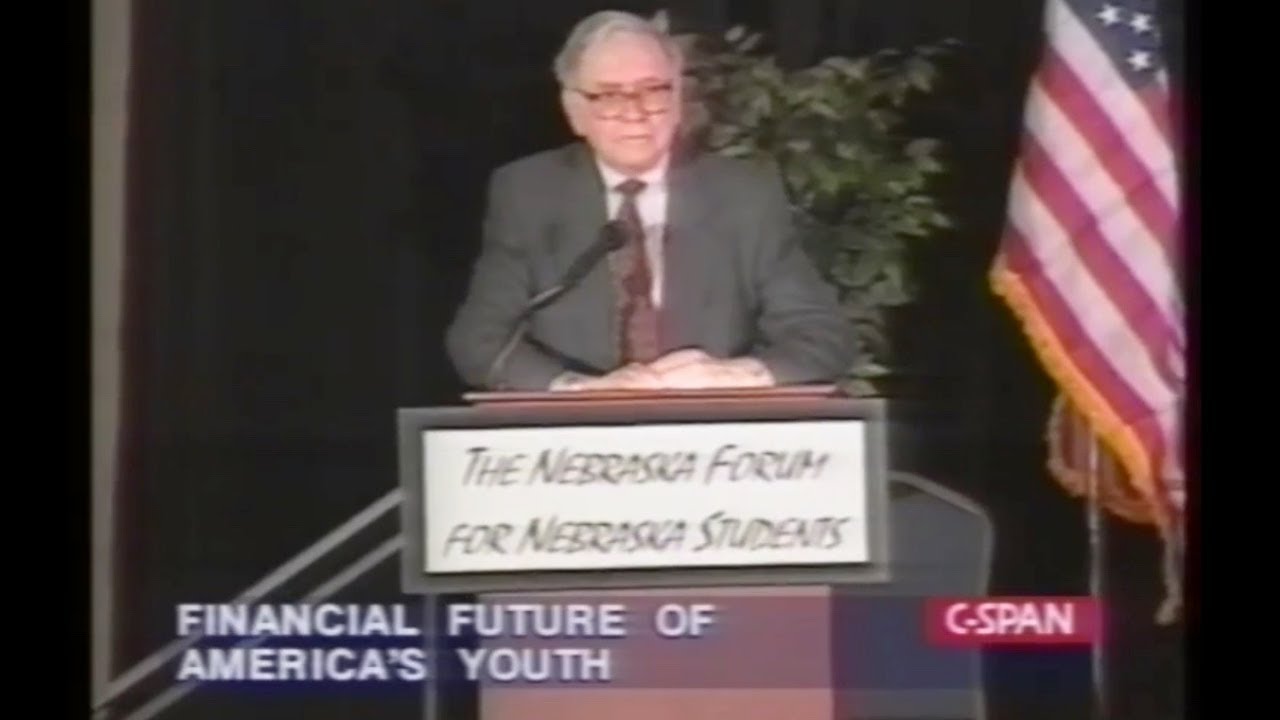
Buffett opens a question-and-answer session with Nebraska students by posing a problem. Imagine he offers to buy ten percent of your financial future: he writes a check today, and from then on you give him a tenth of everything you earn. He suggests nobody should ask for less than fifty thousand dollars, and he may take the low bid, so be careful. If a tenth of you is worth that much, you are worth at least five hundred thousand dollars today. That, he says, is the biggest financial asset you have, by miles, and what you do with it matters far more than choosing between stocks, bonds or funds.
Everyone in the room has the brains and the energy, he says. The question is whether you get the full two hundred horsepower from your engine or only a hundred, or fifty. Two things hold it back: a lack of education, which will affect few in the room, and the habits you develop. When his companies hire, they look for integrity, intelligence and energy. Without the first, the other two will hurt you, because you would want a dishonest employee to be dumb and lazy. Integrity is also a choice: you cannot easily change your IQ, but you can have integrity that matches anybody's.
Habits and the people you admire
Buffett offers an exercise. Write down the person you most admire, someone you would change places with, and why. Then write down the person you would least want to be, and why. Everything on the admired side, such as cheerfulness and generosity, is something you can practice yourself. The traits that repel, such as selfishness, obnoxiousness and egotism, are ones nobody has to have, and you can drop them if you do it early. At fifty or sixty habits are too well formed, but when you are young behavior becomes habit. Repeat the exercise a few years later and you may find the person you admire most is yourself.
A word on credit card debt
His one specific piece of financial advice is to avoid credit cards. His own companies are in businesses that issue them, and Americans love them, but a revolving balance costs eighteen or twenty percent, and you cannot make progress borrowing at that rate. You can make a lot lending at it, but you do not want to be on the side that is always behind. He quotes a partner who says he only wants to know where he will die so that he never goes there: work out ahead of time where you do not want to be.
Buffett receives about a dozen letters a day from people in serious trouble. Some face a catastrophic illness in the family, which is bad luck that only society can address. The other half have credit card debt and cannot even pay the interest, a problem that is avoidable. It is far easier to stay out of trouble than to get out. He had saved about ten thousand dollars when he left school, which he says was worth millions later because it kept him ahead. His rule: if you cannot pay for it, do not buy it.
Careers that do not pay as well
A student asks how to keep up financially in a field, such as performing arts or music, that does not pay a large salary. Buffett agrees that a market system does not always pay in proportion to importance. Teaching is his example: nothing matters more, yet it pays poorly. His advice is to follow what you love. He says it is very hard to find someone his age who loved their life's work but is sad they did not make more money, and he does not think anybody has ever told him they wished they had picked something they disliked in order to get rich. Almost everyone in the room will do reasonably well, he says, unless they pick up terrible habits along the way.
To show how little extra wealth changes daily life, he describes his own. He has lived forty-one years in the house he bought when he had about ten thousand dollars. He eats at Dairy Queen, where anyone can order what he orders, drives an eight-year-old car and watches the same television as everyone else. The one real difference is a more comfortable plane for long trips. A house worth two hundred times his would only bring more worries. Trading work you love for huge wealth that costs you your principles would be a terrible mistake.
Luck, heroes, and being born in the right place
Asked whether he credits his success to himself or to others, Buffett says he was very lucky. If you tell him who your heroes are, he can predict what you will do, and his never let him down, starting with his father. He was born in 1930, when only about one birth in fifty worldwide happened in the United States, so he won the lottery on the day he was born. The students did too: you were several times more likely to be born in China or India, where it is harder to use your talents fully. The timing was lucky as well, since capital allocation pays extremely well today but did not in earlier societies.
Buffett also had terrific parents and a great public school system in Omaha, where the first eight grades at Rose Hill gave him a foundation. He notes a sad reason it was so good: women were heavily discriminated against and mostly limited to being teachers, secretaries or nurses, which concentrated talent in a few jobs. What he does pays enormously well in a market economy, and he calls that an accident, unrelated to any innate ability.
Technology's impact on the economy
A high school student asks about the future role of technology. Buffett says it is turning the world upside down and is only beginning. He recalls meeting Bill Gates on July 15, 1991. Gates tried to educate him about high technology and, he says, would have had better luck with chimpanzees. But Gates made one point stick: Buffett carried a model in his head in which time and distance were limiting factors, and they no longer were. The cost of talking to someone across the world or publishing was heading to zero.
Eight years later, he says, it is exploding. When he considers a business to buy, he asks how the internet affects it. His company had just announced the purchase of a furniture retailer in the Boston area, and he wondered what the internet means for furniture retailing. He recalls that in the early 1980s the country feared the Germans and Japanese would own everything. Within about fifteen years, thanks to the information revolution, the United States holds an incredible position in the most important industry, which argues for a terrific future.
Securing your financial future
Asked how young people can start securing their financial future, Buffett says it is not complicated. It begins with getting full use out of your own talents. Whether you earn X, two X or three X twenty years from now depends less on how much talent you have than on how well you use it. Your ability cannot be taken away, and it cannot even be taxed: if a government doubles the taxes on real estate, it effectively owns more of it, but nobody taxes what is in your head. Most people sleepwalk through life, he adds, so people who perform well jump out at you.
Beyond that, be ahead of the game rather than behind it by saving a little, however you do it. He delivered papers, did odd jobs, sold golf balls and ran a pinball machine route, and ended up with about ten thousand dollars by the time he finished school. In a hundred-yard dash, starting ten or fifteen yards ahead instead of behind changes the result enormously. What matters is not carrying debt when the gun goes off, and not falling behind again by buying things while paying twenty percent interest in between.
Managing education debt
A high school student asks how to deal with debts after college as costs rise. Buffett calls it a tough question. He would pay the debt off as fast as possible and take on as little as he could. In his experience in business, there is very little difference between a very expensive business education and a far cheaper one. He spent a couple of years at Wharton and his last year of college at the University of Nebraska in Lincoln, and he learned just as much at Nebraska.
Much of education is self-taught, he says, and accounting, probably the most important business course, can be learned as well in Omaha as at Harvard. He would bet on it. He acknowledges that some professions, such as medicine, may leave no way around a fair amount of debt, and that is a personal decision. But he would minimize it and work out how to handle it within about five years after leaving school, or think twice before taking it on.
Non-profits and civic involvement
On forming a non-profit organization, Buffett says he has always tried to avoid forming them. What to do depends entirely on what you want to accomplish, and you need experienced people involved. Asked about civic involvement, he says he is not that civically involved. The model for an Omaha citizen is Walter Scott, whose civic work goes beyond his. Buffett loves his business so much that it takes over, like a man who plays a lot of golf. People do what they want to do, he says, and he has never met anyone who enjoyed civic work and did not find it worthwhile afterward, because building something is fun.
The biggest economic problem facing youth
A student asks what will be the biggest economic problem for today's youth. Buffett does not expect enormous ones. He thinks the average person will live significantly better than the average person one or two generations earlier, as has been the history of this country. With four and a half percent of the world's population, the United States holds fifty-three percent of the value of the world's publicly traded corporations. Over the last hundred years the country has met a long list of problems, and those who fixated on them missed the larger picture: every generation lives better than the one before. He credits savings and an environment that lets people realize their potential.
He adds that the system throws up leaders. Instead of a commissar running a big business, you get someone like Jack Welch, who makes a night-and-day difference to productivity over decades. Productivity is what raises the standard of living, so a system that finds such people has a huge advantage. Buffett tells the students they have the best future, in terms of material rewards, of any generation, and he wishes he could trade places with them.
Y2K and the stock market
A student asks whether Buffett, or Gates, feared the effect of Y2K on the economy or the stock market. Buffett says he is the last person to understand it: he does not know why the microphone works or why lights come on, and he flips the switch on his television and prays. But the smartest people he knows in that area largely think it will be a non-event in this country. He expects you will wake on January 1st to find the world no different from December 31st.
Moats, circle of competence, and the discipline to wait
Asked how he decides where to invest, Buffett says he looks for businesses with good economics, meaning a moat that makes the product, service or location a little more desirable to customers than comparable ones. His example is Snickers, the top candy bar for thirty or forty years. He cannot say where information technology businesses will be in ten or fifteen years, but he knows Snickers and Wrigley's gum will sell much as now. The key is predictability of a lasting competitive advantage. Then he looks for honest and able managers, which is easier than finding businesses that stay wonderful.
He needs to find very few. One a year is terrific. What matters is discipline, not brainpower: you do not need a 150 IQ, or 140, perhaps 115. You must wait for the fat pitch, because investing is a game with no called strikes. In business you can sit as long as you like while the paper lists General Motors or General Electric at prices you dislike, and swing only a few times in a lifetime. He stays within what he calls his circle of competence. He does not know what cocoa beans or crude oil will do next year and does not need to.
Most people get into trouble because they get itchy and hear of others making money. Nothing upsets people so much as friends making money, he says, and it destroys discipline. Active trading loses money over time. Whenever you buy, you should be able to write on one sheet of paper why, and a cocktail party tip or a broker's pitch is not a reason. A farm purchase works the same way: you work out the price per acre and the expected earnings. A stock is a little piece of a business. Buy it at an attractive price for the whole business and you will make money, and if you do not, over time you will not.
Moral standards in society and business
A student relays a speaker's view that falling moral standards will eventually affect business, and asks how Buffett sees it. He says moral standards are very hard to quantify over time, since at any moment you can point to huge weaknesses and huge strengths. On balance he thinks the country has made real progress in institutionalized moral standards: a century ago women could not vote and had lesser rights, and the income tax did not exist. There is an enormous distance still to go, but the direction is right, maybe by fits and starts.
Civil rights is his example. It took television to dramatize what was happening, and it reached the conscience of people who preferred not to think about it. The pace may seem slow to those involved, and he understands that. Women's suffrage, he notes, went on for decades. His view is that the country's moral behavior has improved and will keep improving, and he hopes everyone in the room will do their part.
Should you invest now, with the market so high?
Asked whether to start investing now, with the market high, or wait for a decline, Buffett says he cannot tell anyone whether to buy stocks now. In general, saving matters more than whether the money goes into the market. But if you are interested and have a little capital, buy some, because there is no better way to learn than experience. Losing money on paper and losing real money are different experiences. He bought his first stock at eleven, three shares of Cities Service Preferred at 38. It fell to 27, which he still remembers, then rose to 40, when he sold and made five dollars after commissions.
Between eleven and nineteen he studied charts and technical analysis and read every book he could find, and he did not do that well. At nineteen, at the University of Nebraska in Lincoln, he bought the newly published The Intelligent Investor by Ben Graham, and it had an enormous impact. He is not sure it would have hit so hard without those eight years of floundering, because part of life is getting prepared so that you grasp the significance of something when it arrives. To this day he writes down why he is buying, then rereads it a year later. Businesspeople avoid postmortems, but you must learn from some of your own mistakes, and the time is when you are young.
Is the government prepared? The ovarian lottery
Asked whether government policies on welfare and Social Security are fiscally prepared for the future, Buffett says the country as a whole is well prepared, though that does not mean he would adopt every policy. It is an enormously rich society and will get richer. Not everyone will share in it, because of physical or mental disabilities or shortcomings in education. The society is prosperous enough to take care of those people, and should, in a way that lets them feel useful and keeps encouraging productivity.
He then poses a thought experiment. Twenty-four hours before you are born, a genie lets you design the political, economic and social rules of the world you will be born into. The catch is that you do not know whether you will be black or white, male or female, rich or poor, bright or not, able-bodied or infirm, American or Afghan. You reach into a barrel of six billion balls and take one, which he calls the ovarian lottery. What rules would you want? A system that pushes able people to work to their potential, but also cares for those who draw the wrong ball.
The media's economic effect
The final question asks how the media affects the world economically. Buffett jokes that it is a small question. Because media has advanced so far technologically, it brings the world together. On a visit to China after the Women's Conference in Beijing he read the Chinese coverage, which bore no relation to what happened, but the internet was arriving, and you can now read The Washington Post or The New York Times from anywhere.
The ability to communicate, and the degree to which the world can know what is happening everywhere, has been a quantum leap. Instant access to information everywhere could drive advances in medicine. Net, he considers it a plus over time. In the early 1960s there were three television networks, and now the choices are unlimited. Then he thanks the audience and wishes them well.
Raw automatic captions from YouTube, in English, without edited punctuation.